The End of Platform Analytics? Why Data Dashboards Have Become the New Bureaucracy

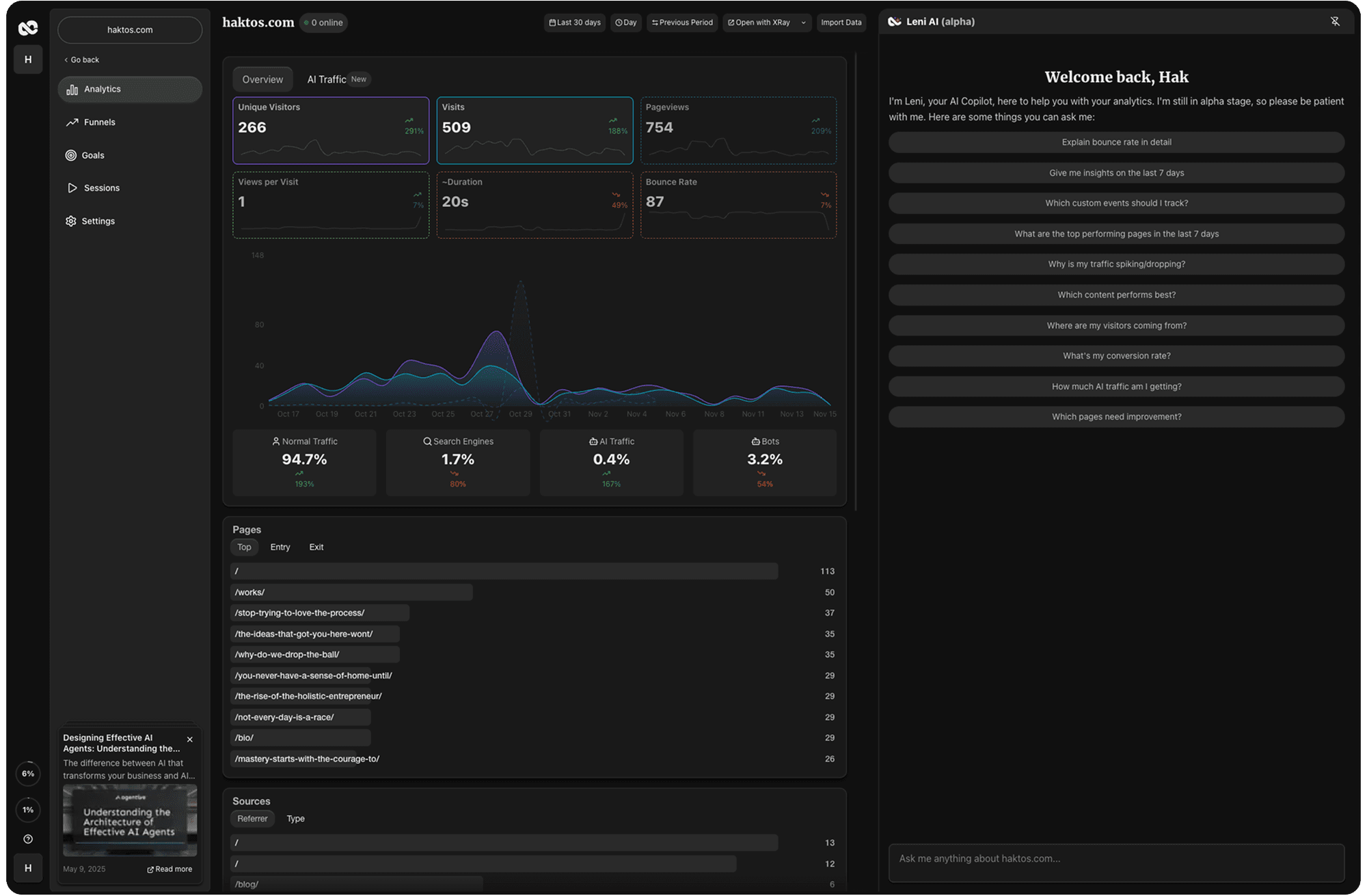
Data Dashboards were supposed to free us. Instead, they’ve turned into the digital equivalent of office paperwork.
If you’ve ever logged into Google Analytics, Adobe Analytics, or any of the newer players promising “simplicity,” you’ve probably felt it too: the creeping sense of overwhelm. Tabs stacked on tabs. Filters hidden in menus. Reports nested five clicks deep.
Dashboards were meant to give us clarity, and for quite some time, they certainly did. However, for a while now and for many reasons, there is a paradoxical feeling of too much and, at the same time, not enough. Too much data and not enough ways to break it down and act on it. If you’re a data scientist, sure, you’ll find ways. But most of you reading this are not, am I right?
Therefore, in this article, we’ll unpack the following:
- How traditional data dashboards are no longer the answer
- The consumer behavior shifts that make them close to unbearable, in 2025.
- Why should companies look towards “applied” analytics - data insights that live where the action happens.
- And what the future looks like when analytics become “invisible”.
1. The Rise (and Fall) of Dashboards
When the first analytics platforms came on the scene, they were revolutionary. Suddenly, a marketer or business owner could see - in real time -how many people were on their site, what they were clicking, and where those users came from.
The dashboard became the control center. One login, one screen, and there you had it: the “heartbeat” of your digital business.
But like every great idea in tech, success bred bloat:
- Google Analytics (GA) grew from a neat counter, to an enterprise-level cockpit. It’s brilliant, as you can get the basics for free and with only a little “pain”, but unless you’re a proper data analyst, diving deeper and extracting use insights might feel out of your league.
- Adobe Analytics became a flexible powerhouse. But with flexibility comes complexity - it’s like building IKEA furniture blindfolded.
- Even the “simpler” alternatives like Plausible, Fathom, or Simple Analytics still center their value on - you guessed it - another dashboard.
The result? What once felt empowering, now feels like a lot of work, for a questionable level of impact. Dashboards became the new tech bureaucracy: heavy, slow and intimidating.
2. Consumer Behavior Has Outgrown Dashboards
Here’s the kicker: it’s not just that dashboards have grown more complex, it’s also that human behavior has significantly changed, and it’s still changing. Some say that we’re evolving, others say that we’re regressing. Maybe it’s still too early to tell.
Still, what is clear is that technology has reprogrammed our patience, ability and even willingness to learn how to deal with complex setups. What once felt intuitive and natural, it’s now quickly becoming too much to handle (cough Dashboards cough). A breakdown of that looks like:
- We live in the age of one-click gratification. If Spotify can recommend your next song, and Notion can autocomplete your thought, why should checking analytics feel like filing taxes?
- No-code tools like Webflow, Canva, and Zapier have trained people to expect frictionless experiences. The website analytics space hasn’t caught up, yet.
- SaaS fatigue is real. By now, we know businesses don’t want “another tool to check.” They want fewer touchpoints, not more.
And perhaps the most important aspect: time has become the scarcest currency. Sound familiar?
Business owners, marketers, agencies - they’re drowning in meetings, campaigns, Slack pings. Spending 30 minutes spelunking through a dashboard isn’t just annoying; it’s becoming costly on all fronts.
The result? A growing wave of what we call dashboard fatigue. People don’t log in. Reports go unread. Data sits idle, and maybe worst of all, decision-making falls back on gut feel - the very thing that data & analytics was supposed to prevent. Now that’s an irony, if you were looking for one.
3. The Shift Toward Visual and “Applied” Analytics
Enter the new category: “applied” website analytics.
Here’s exactly what that means: Instead of sending people away from their work onto another platform, “applied” website analytics brings the KPIs and data insights, directly onto your website. At this point, you might not yet understand what we mean (unless you’ve already seen our Demos), so let’s deep dive.
Imagine this: you’re editing a landing page. You hover over a button, and instantly see its click-through rate (CTR). You glance at a Hero image and see how many people scrolled past it. You review a checkout page and see where most users drop off.
No dashboards. No filters. Just the usual KPIs, in the context and environment where they make sense: your website.
That’s visual + applied analytics in action. It’s a lens, not a platform. It saves time, cuts learning curves, and makes data actionable, not passive.
And when paired with AI? Game-changer. Instead of just seeing that 60% of people drop off at checkout, your analytics lens might tell you: “Most drop-offs happen at the shipping step. Simplify the form to improve conversions.”
That’s not just reporting. That’s advising. Pretty cool, right? If you’re not hooked yet (there might be something wrong with you (kidding)), keep reading to learn how could “applied” analytics work for you, whether you’re a Founder, managing a small Team or working in a large corporation.
4. Why This Matters for Businesses (Big and Small)
Moving from just theory, to tackling and solving real pain points:
- For Founders: no more wasting hours learning GA4’s quirks. How about seeing your website’s performance at a glance, and acting on those KPIs?
- For SMEs: it reduces tool fatigue. Analytics becomes invisible, embedded, always there. Discuss directly on the matters, not in PowerPoint presentations.
- For Enterprises: “applied” analytics reduces reporting overhead and drastically reduces the skill gap required to read and contextualize website data.
We are introducing our solution as an answer to the already established “tool fatigue”, and the increasing need for acceleration, whether it’s on analysis, understanding, contextualization or the action itself.
5. A Critical Take: Why Platforms Won’t Solve This
Alright, if you’re still reading this, by now you should have found yourself in some of the above. You might still hear talk of “…but GA4 is getting more user-friendly, adobe has AI features and others promise lightweight dashboards…”, but here’s the issue: they’re still platforms working on the same old concept of delivering website analytics.
No matter how good and “clean” the UI becomes, they still require:
- A context switch.
- A mental model for navigation.
And in 2025, when consumer expectations are shaped by TikTok’s instant gratification or ChatGPT’s conversational answers, expecting people to “go check a dashboard” is becoming outdated.
That’s why this isn’t a UI problem. It’s a category problem. Dashboards themselves are no longer the complete answer.
Full transparency moment: we also give you the option to interact with dashboards and an analytics-only platform, but that is a choice for you to make, not the only solution.
6. The Future: Analytics That Disappear
Ironically, the future of analytics might be no analytics at all — at least not in the way we’ve gotten to known the space.
The best tools won’t look like tools. They’ll be invisible, always-on, feeding back just enough insight to make your next decision easier, intuitive and truly data-driven, as it should be.
We’ve already seen this in other areas:
- Grammarly doesn’t make you open a grammar dashboard. It works where you write.
- Figma doesn’t ask you to export reports. It shows edits live in the file.
- Calendly doesn’t give you a calendar dashboard. It embeds availability into links.
The Website Analytics space is heading in the same direction. The end of platform analytics isn’t just an end. It’s the beginning of a future where insights are ambient, contextual, and human-friendly. In fact, it’s not an end, as we’ve clarified above, it’s an evolution. We’ll probably still use Dashboards and Charts, to get our point across to others, but for when you need to decide what to do with the data and the insights that you’re getting, the “action” should happen where your business happens - your website.
7. Why “Applied” Analytics Deserves Its Own Category
Just like “no-code” or “low-code” became categories in their own right, “applied” analytics deserves recognition as the natural next step to breaking the barriers that are currently preventing Founders, SMEs and even Enterprises, from maximizing the output of their website analytics. More specifically:
- It solves dashboard fatigue and significantly reduces the “entry barriers”, meaning that you no longer need to be a “data guru” to understand and work with your data.
- It matches consumer behavior shifts toward instant, embedded experiences. Why shouldn’t we also work behind the scenes in the same way?
- It aligns with privacy-first needs (tracking without intrusive and non-compliant cookies).
- It leverages AI to turn data into concrete advice and next steps. Finally, a direct answer to the “so what?” question of website analytics.
It’s not about competing head-to-head with GA4, Adobe, Plausible and the hundreds of other website analytics platforms. It’s about reframing the conversation: those are platform analytics. We are the evolution of this space: “applied” analytics.
8. Closing Thought
Dashboards and the overall traditional analytics platforms have had their moment. They democratized data. But today, it feels less and less like empowerment and more like bureaucracy. In a digital-first world, meaning of world of data abundance, we need to make it as easy as possible for anyone to understand and work with their data. No worries, you can still do a PHD in Data, but for the Entrepreneur or the Start-up that still cannot afford a data team, we have built Sitelens for you.
The next chapter belongs to solutions that respect people’s time, meet them in their working environment, and make analytics disappear into the background. Data is no longer the main character. Usability and action are.
The evolution of platform analytics isn’t just coming - it’s already here, and for businesses ready to embrace it, the payoff is huge: less time wrestling with dashboards, more time for action and for growth.