Sitelens vs Google Analytics: Which Analytics Tool Is Right for You in 2026?

Introduction
Google Analytics is the most widely used web analytics tool on the planet. It’s also, for most small and mid-sized businesses, far more than they need — and increasingly, a legal liability.
In 2026, the question isn’t whether Google Analytics is powerful. It clearly is. The question is whether that power translates into actual value for your business, or whether you’re spending hours navigating a platform built for data scientists, while your website quietly loses conversions.
This is an honest comparison of Sitelens and Google Analytics (GA4). We’ll cover features, privacy, ease of use, AI capabilities, and who each tool is actually built for. Of course, we may be biased in our assessment.
Two Very Different Philosophies
At their core, these two tools represent opposite philosophies about how analytics should work.
Google Analytics is a centralized reporting platform. Your website sends data to Google’s servers, and you access insights through a separate dashboard — navigating menus, building custom reports, and switching between your site and your analytics tab to make sense of what’s happening.
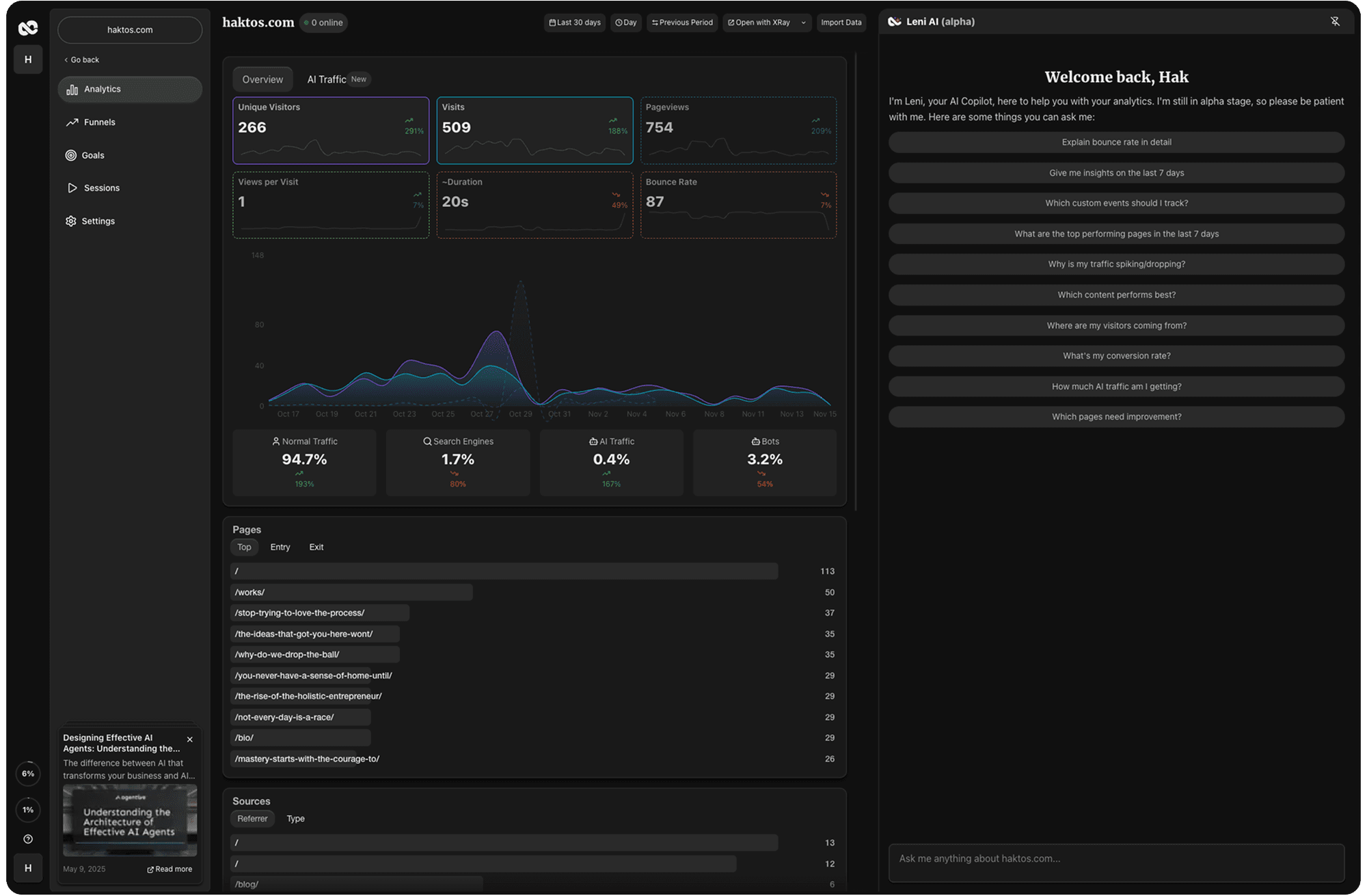
Sitelens does something fundamentally different. The analytics live on your website. You hover over any page element — a button, a section, a CTA — and you see how visitors interact with it, right there, in context, without opening another tab. It’s the difference between having a data analyst in a separate office you must call, and having one standing next to you while you work.
One approach adds a step. The other removes it entirely.
Feature-by-Feature Comparison
Both tools track core website metrics — visitors, pageviews, traffic sources, bounce rates. But the experience of accessing that data, and what you can do with it, is where the comparison diverges sharply. The table below breaks down the key differences across setup, privacy, AI, and behavioral analytics.
|
Feature |
Sitelens |
Google
Analytics (GA4) |
|
Setup time |
1 line of code, ~5 minutes |
Multiple tags, Google Tag Manager, 30–60 min setup |
|
Interface |
Embedded on your website |
Separate platform (tab switching required) |
|
AI insights |
Leni AI — plain English answers and recommendations |
No built-in AI assistant (probably in the works) |
|
Learning curve |
Minimal — designed for non-technical users |
Steep — built for analysts |
|
Cookie consent required |
No |
Yes |
|
GDPR compliant |
Yes — EU-hosted, no personal data transferred |
Partial — data transferred to US servers (legal risk in EU) |
|
Session replay |
Yes |
No |
|
Heatmaps |
No |
No (requires separate tool e.g. Hotjar) |
|
Conversion funnels |
Yes (simple, on website setup) |
Yes (complex setup) |
|
AI traffic detection (ChatGPT, Perplexity) |
Yes |
No |
|
Script weight |
<7KB |
~45KB |
|
Data ownership |
Yours |
Google’s |
|
EU hosting |
Yes |
No |
|
Pricing |
Paid plans, free trial |
Free (you are the product) |
The table above reflects a fundamental trade-off. GA4 gives you more raw data configuration options and deeper integration with the Google ecosystem (Ads, Search Console, Looker Studio). Sitelens gives you faster answers, without the complexity tax — and without privacy compromises.
Where GA4 Has the Edge
GA4 is free — for businesses on tight budgets, that matters. Its deep integration with Google Ads and Google Search Console is unmatched; if paid search is a core channel, GA4 is hard to replace entirely. Looker Studio (formerly Data Studio) integration enables advanced custom reporting for teams that need it. The sheer volume of GA4 documentation, community support, and training resources means a skilled analyst can build almost anything with it. For large enterprises with dedicated data teams, GA4’s flexibility is genuinely powerful.
For most small and mid-sized businesses, however, that flexibility comes at a cost: complexity that doesn’t convert into action.
Where Sitelens Has the Edge
No dashboard switching. The most important feature in Sitelens isn’t a feature — it’s the absence of one. No separate platform to learn, log into, or navigate. Your embedded analytics are on your website, where you already spend your time.
Leni AI turns data into decisions. GA4 shows you numbers. Leni tells you what they mean and what to do. You can ask your AI analytics assistant in plain English — “why is my homepage bounce rate so high?” — and get a direct answer, not a chart.
Privacy-compliant by default. No cookies, no consent banner, EU-hosted. For European businesses especially, this GDPR compliant analytics solution removes liability without any configuration work. GA4 requires active compliance management; Sitelens removes the problem entirely.
Session replay, heatmaps, and conversion funnels — built in. In GA4, getting this level of behavioral insight requires a separate tool (Hotjar, Microsoft Clarity, or similar), a separate subscription, and more tab switching. Sitelens includes all three natively as part of its web analytics tool.
AI traffic detection. In 2026, a meaningful share of referral traffic comes from ChatGPT, Perplexity, Claude, and other AI platforms. Sitelens tracks it. GA4 largely misses it, labelling it as direct or referral with no meaningful distinction.
Designed for non-technical users. Sitelens was built for founders, marketers, and business owners — not data scientists. If you’ve ever opened GA4 and immediately closed the tab, you know exactly what this means.
GA4 and GDPR: The Risk Most Businesses Ignore
In 2022 and 2023, regulators in Austria, France, Italy, Denmark, and Finland all issued rulings declaring that Google Analytics is illegal or non-compliant under GDPR, because it transfers EU user data to US servers without adequate legal safeguards.
Many businesses are still running GA4 on their websites despite this. The fines are real — the French CNIL levied €10 million against Google Analytics users — and the enforcement trend is moving in one direction.
Sitelens is built and hosted in the EU. No personal data is transferred outside EU jurisdiction. No consent banner is required. For any business operating under GDPR, this is not a minor advantage — it’s a structural one. As a true Google Analytics replacement, Sitelens offers privacy-friendly analytics without compromise.
The Honest Verdict
Choose Google Analytics if: You’re heavily invested in Google Ads and need native attribution. You have a dedicated analyst or data team. You need Looker Studio integrations. You’re on a zero budget.
Choose Sitelens if: You want analytics that work with your website, not in a separate tab. You’re a founder, marketer, or agency owner who needs answers, not charts. GDPR compliance matters to your business. You want session replay, AI insights, and conversion funnels without paying for separate tools.
Conclusion
Google Analytics is not a bad product. For large organizations with data teams and a heavy Google Ads dependency, it remains the standard. But for the vast majority of businesses — startups, SMEs, agencies, and digital teams that need fast, clear, and actionable insights, GA4 has become a liability disguised as a free tool.
Sitelens was built for those businesses. Analytics that live on your website, not in another tab, powered by AI that tells you what to do next.
Try Sitelens free at Sitelens.co — no credit card required, set up in five minutes.